
Inside the LPRC Study: How Researchers Actually Measured SmartDome's Impact

Who ran the study and how? The theory being tested What shoplifters said when asked directly What store employees noticed
Share this article

Most loss prevention claims come from whoever is selling the product. A shrink statistic in a datasheet, a case study with the specific numbers left out, a demo that looks convincing in the room. None of that is necessarily wrong, but none of it is independent either.


The research behind SmartDome is different in one important respect: it was not conducted by SmartDome's manufacturer, Indyme, but by the Loss Prevention Research Council (LRPC), an independent research body that exists specifically to test whether loss prevention technology does what it claims.

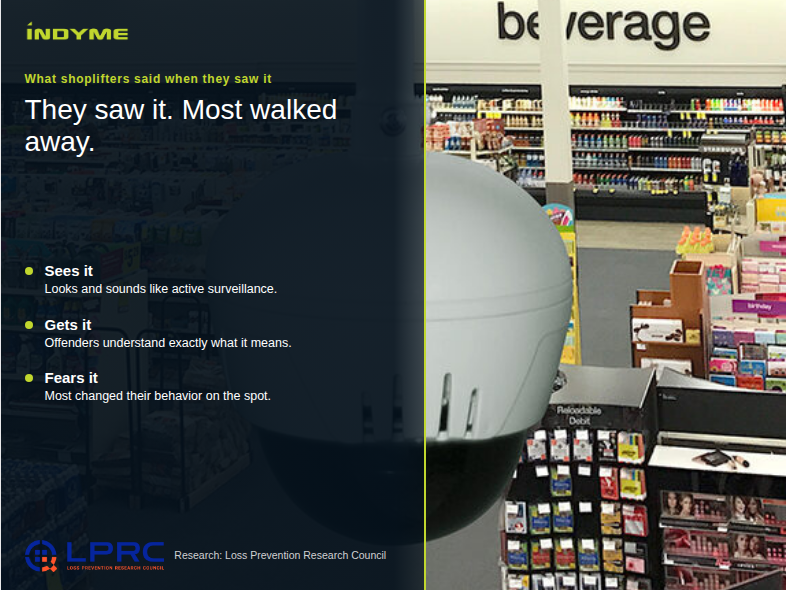
SmartDome mounted above a retail aisle, with the heading 'They saw it. Most walked away,' and three points: Sees it, looks and sounds like active surveillance; Gets it, offenders understand exactly what it means; Fears it, most changed their behavior on the spot.

The LRPC looks at SmartDome and its role in active deterrence.

Key Takeaways
  • The study was run independently. LPRC, a research body with no commercial stake in SmartDome, designed and conducted the 12-month, 95-store pilot.
  • The results held from three separate angles. Shrink and sales data, customer interviews, and self-admitted shoplifter interviews all pointed the same direction, which is harder to dismiss than any single metric alone.
  • Deterrence worked without hurting the shopping experience. Cosmetics shrink fell 10-15% while category sales rose 1-2% over the same period, ruling out the simplest alternative explanation that the category just got harder to shop.
  • Shoplifters said it changed their behavior. Of the 12 offenders interviewed, 75% said they'd alter their plans on the spot: leaving empty-handed, going elsewhere, or swapping for an unprotected item.
  • Customers and employees both rated it well. 90% of shoppers said they felt comfortable around the technology, and every employee interviewed rated it effective at deterring theft without getting in the way of their job.

Who ran the study, and how?

The study, In-Store Impact of Active Deterrence Technology, was conducted by LPRC researchers Natanya Cruz, Samuel Auer, and Read Hayes, Ph.D., and published in May 2020. LPRC worked with a national drugstore chain to install SmartDome across 95 stores for a 12-month pilot, targeting the cosmetics category, historically one of the hardest categories in a drugstore to keep off the shrink report. Shrink and sales data were collected before and after installation and compared against a matched set of control stores that never received the technology, so the pilot stores' results could be measured against what those same stores would likely have done on their own.


A before-and-after comparison against a control group answers one question: did the numbers move. It does not answer why they moved, or what else changed along the way. For that, LPRC researchers went into the test stores and talked to the three groups of people who actually experienced the technology firsthand: shoppers, self-admitted shoplifters, and the store employees working alongside it every day.

The theory being tested 

The study is explicit about the theory behind it. It draws on Ronald Clarke's situational crime prevention model, which holds that an offender is less likely to go through with a crime as the effort required goes up, the risk of getting caught goes up, or the reward for succeeding goes down. LPRC also evaluated SmartDome against a simpler three-part framework it calls See, Get, Fear: for a deterrent to work, a would-be offender has to notice it, understand what it does, and believe it is a credible threat rather than background decoration. Everything the study measured, from the offender interviews to the shrink numbers themselves, traces back to one of these two frameworks.

See SmartDome in action!

Get in touch with our team of experts. Whether you're looking for a specific product or a comprehensive solution, our team is ready to provide the guidance you need.

What the shrink and sales data showed?

Over the 12-month period, cosmetics shrink in the SmartDome-protected stores fell 10-15% compared to the control stores. Category sales moved the other way, up 1-2% over the same period. Reported together, those two numbers rule out the simplest alternative explanation: that the stores had simply made cosmetics harder to shop, losing honest sales along with the theft.

What shoppers actually experienced

LPRC researchers intercepted 30 customers in the test stores to ask what they noticed and how it made them feel. 76.67% could point out some form of anti-theft technology in the area, and 63.33% specifically identified SmartDome by name or description, evidence that the See half of the framework was working as intended. Comfort held up alongside that awareness: 90% described feeling somewhat or very comfortable around the technology, 70% of those very comfortable, and 56.67% felt very safe with another 26.67% somewhat safe. Asked whether the technology changed their likelihood of shopping there again, 56.67% said it made them more or much more likely to return, and not one customer said less likely. On a set of agreement statements, customers rated the technology easy to understand (4.03 out of 5) and effective at preventing theft (3.90 out of 5), while rating the statement "this technology makes for a less convenient shopping experience" at just 1.23 out of 5, close to strong disagreement.

What shoplifters said when asked directly

SmartDome_FeaturedMeta_dome_led_1200x630_1

The most unusual part of the study is also the most direct: LPRC recruited and screened 12 self-admitted shoplifters and asked them, plainly, how SmartDome affected their decisions. 91.67% noticed the technology when prompted to identify anti-theft measures in the store, and the same share correctly understood that its purpose was to prevent theft. Every offender interviewed, 100%, overestimated what the technology could actually do, describing it as a camera, several specifically guessing at facial recognition or constant live monitoring that neither version of SmartDome performs. Two-thirds, 66.67%, believed they were being actively watched through it in real time.


Asked how likely they would be to steal an item protected by the technology, on a five-point scale, offenders rated it 2.58 on average, toward the unlikely end. Asked what they would actually do if they encountered it while attempting to shoplift, 75% said their behavior would change in some form: 33% said they would leave without taking anything at all that trip, 25% said they would go to a different store entirely, and 17% said they would swap the item for something similar that was not protected. Only 25% said they would still take the item regardless. When offenders rated SmartDome's deterrent value against five common passive technologies on the same five-point scale, they rated it a stronger deterrent than every one of them, from public-view monitors (3.42) up through closed-circuit TV (4.42).

What store employees noticed

The study did not stop at customers and offenders. LPRC also interviewed nine store employees, with an average tenure of nearly four years at that location. Every employee surveyed, 100%, rated SmartDome as either somewhat or very effective at deterring theft, and 100 percent said it did not hinder their ability to do their job. The large majority, 77.78%, found the alerts easy or very easy to fold into their normal workflow, and two-thirds reported the technology had a positive effect on their ability to serve customers.

Why the methodology is the real headline

Any one of these findings on its own would invite a reasonable objection. A shrink number alone could reflect a category that just got harder to shop rather than a real deterrent. A comfort survey alone could miss whether theft actually changed. An offender's self-report alone could be unreliable. Measured together, against an explicit theory of how deterrence should work and checked from three independent vantage points that each had a reason to disagree, the pieces corroborate each other in a way no single metric could.


That is the case for reading the source itself rather than a summary of it, Indyme's or anyone else's. For teams evaluating active deterrence, or building their own business case internally, the full LPRC report includes the complete methodology, every survey question asked, and the data tables behind every figure cited here. 

Talk to an expert

High-shrink categories have been the hardest part of the store to protect without adding staff or slowing down honest shoppers, not because retailers haven't tried, but because most deterrents only work if someone is already watching. SmartDome changes that math: a visible, always-on deterrent, now backed by independent research showing it changes behavior in the moment, not just on paper.


Curious what active deterrence could look like in your stores? Let's talk.

Go to Solution Read the Full Study
Author

Indyme, Inc.