
- Home
- Resource Listing
- Silent Response Buttons: What Changed and What NY Retailers Must Do by 2027
Silent Response Buttons: What Changed and What NY Retailers Must Do by 2027
Troy Anderson
If you've been tracking New York's Retail Worker Safety Act since it passed, you may still be thinking of it as a “panic button” law. It isn't anymore — and the difference matters for how you plan your compliance timeline.
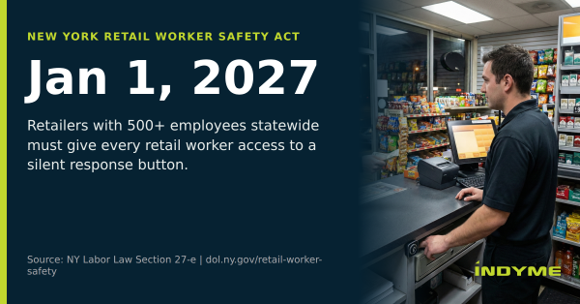
The January 2027 silent response deadline.
- Retailers with 500+ employees statewide must provide works with access to a silent response button.
From Panic Buttons to Silent Response Buttons
As originally written, the law would have required “panic buttons” at retailers with 500 or more employees nationwide. An amendment signed by Governor Hochul in February 2025 — just 18 days before the law's original effective date — changed the terminology to silent response buttons and narrowed the requirement to employers with 500 or more employees statewide in New York.
The distinction between a panic button and a silent response button isn't just naming. A silent response button is designed to notify internal staff — a security officer, manager, or supervisor — rather than triggering a direct alert to law enforcement. The intent is to route incidents through a controlled, internal response first, reducing false alarms that could otherwise overwhelm local police departments, while still guaranteeing an employee in distress gets help fast.
Who Actually Needs to Comply?
The silent response button requirement applies to retail employers with 500 or more employees in New York State (not nationwide, following the amendment) as of January 1, 2027. If your total NY headcount is below that threshold, this specific requirement doesn't apply to you yet — though the separate workplace violence prevention policy and training requirements (covered in our previous post) apply to any retailer with 10 or more employees, regardless of size.
See Indyme's Help Buttons in action!
Get in touch with our team of experts. Whether you're looking for a specific product or a comprehensive solution, our team is ready to provide the guidance you need.
What the Button Has to Do
At minimum, a compliant system must let an employee discreetly “request immediate assistance from a security officer, manager, or supervisor in case of emergency.” Employers must also train employees on how to use the system as part of their broader workplace violence prevention training.
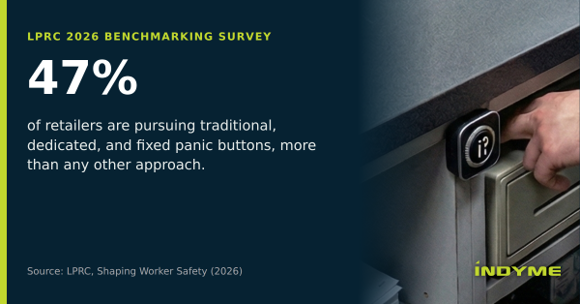
47% of retailers are pursuing traditional, dedicated, fixed panic buttons — more than any other approach. Source: LPRC, Shaping Worker Safety (2026).
Planning Your Timeline
January 1, 2027 sounds distant, but the work behind it isn't quick:
- Audit your NY headcount across all locations to confirm whether you cross the 500-employee statewide threshold.
- Evaluate your current systems. Many retailers already have some form of emergency notification in place — the question is whether it meets the specific “silent,” internally-routed design the law requires, and whether it can be verified across every applicable location.
- Plan procurement and installation lead time. Hardware selection, purchasing approvals, and store-by-store rollout can take months, especially across a large multi-location footprint.
- Build the training into your existing program. Since button training must be part of your required violence-prevention training anyway, plan to introduce both together rather than as separate initiatives.
- Document everything. As with the broader policy requirement, keeping clear records of what was installed, where, and when your staff were trained will matter if the state's complaint process is ever triggered at one of your locations.
Keep Watching for Updates
Given that this requirement has already been amended once — with real, substantive changes made just weeks before a deadline — it's worth treating January 1, 2027 as a target to be ready well ahead of, not a date to plan against right up to the wire.
This post is for general informational purposes and isn't legal advice. Consult with counsel to confirm how the Retail Worker Safety Act applies to your specific business.
Troy Anderson