
The Door No One Can Staff All Day: How self-service access is changing the math on retail restroom and fitting room safety

The Room Nobody's Watching What the Field Data Actually Show Where and How It Fits
Share this article

The Room Nobody's Watching

Picture1


Every retailer has a room that sits outside the sightlines that stop most loss prevention programs: the restroom, and increasingly, the fitting room. It's a sentiment we hear often from asset protection leaders: restrooms are where incidents hide. You can't staff a door all day, and when something happens, there's often no record of who went in or how long they stayed.


The current playbook is thin. Cameras near the entrance, scheduled associate checks, informal walk-bys, a pin code on the door. None of it changes the underlying dynamic: anyone can enter, anonymously, for any reason. Pin codes in particular degrade fast, they leak, they spread to the people you'd most like to keep out, and they generate zero intelligence about who's actually using the space. Associate-mediated unlocking works, but it's a roughly three-minute round trip every time, and it provides minimal deterrence since an associate will open the door for anyone who asks.


Fitting rooms carry a related but narrower version of the same problem, weighted more toward shoplifting than the broader antisocial mix. Some retailers lock every fitting room. Some staff an attendant. Many leave them open. Both spaces deserve the same answer: not more staffing, but a door that knows who's on the other side of it.
 

FreedomGo_Blog_DoorLockSign_450_square

Hinder antisocial behavior with value exchange

Key Takeaways
  • Having associates manually unlock doors is time-consuming and inefficient.
  • Doors without locks and those with Pin codes provide anonymity with can fuel antisocial behavior.
  • By capturing customer credentials, anonymity is removed with hinders antisocial behavior.
  • Customers are accepting of self-service locks.

The Value-Exchange: A Door with an Identity Layer
 

FreedomGo_BlogHeader_photo


Freedom GO extends Indyme's Value Exchange, already proven in Freedom Case, to these locked rooms. The idea is simple to state and hard to copy: honest shoppers get in faster than they would with a staffed or coded door, and the moment someone provides a credential to enter, they give up the anonymity that makes these spaces attractive to bad actors in the first place. It's the same logic behind the LPRC's See-Get-Fear framework for situational crime prevention, applied at a door instead of a camera.


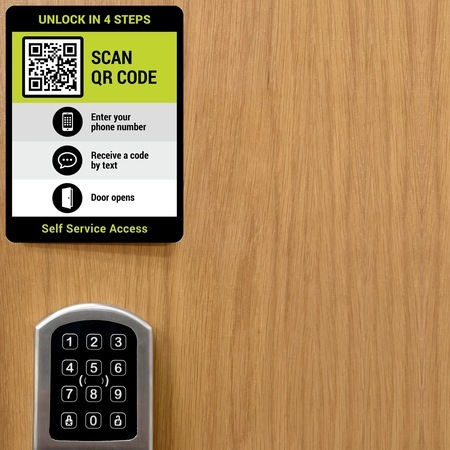
In practice, a shopper scans a QR code posted on the door. First-time visitors enter a phone number and confirm a one-time code; the door unlocks the moment it's verified. Returning shoppers skip that step entirely; a saved credential on their phone unlocks the door with zero input. Every visit, whichever path it takes, becomes a session record: credential, entry time, and dwell, logged automatically.


Nobody is forced through a screen. Any shopper who can't or doesn't want to use self-service can ask an associate instead, a first-class option, not an afterthought. And store associates never lose access: a keypad PIN, cached locally on the lock, keeps working even if the network doesn't.

  • Value Exchange already proven with Freedom Case
  • First-time shoppers enter a one-time code
  • Returning shoppers skip code entry process and enter with saved credentials
quote_big_icon

Proven Impact:


In a joint field study with the Loss Prevention Research Council, Freedom GO was deployed across five pilot stores over five months. The results below are pooled across the deployment.


       • $23-24K saved per store, per year in reclaimed associate labor*
       •  About 70% of visits are self-service


 *Assumes a 3-minute associate round trip per assisted unlock, based on a joint Indyme-LPRC field study across five pilot stores (Nov 2025–Apr 2026). Adoption and uptime figures are pooled across the same study. 

LPRC Pilot Study
quote_big_icon

What the Field Data Actually Show

Indyme ran a joint field study with the Loss Prevention Research Council, led by Dr. Justin Smith, LPRC's senior research scientist, across five stores over roughly five months. The results are specific enough to be useful, and honest enough to include what didn't work.


  • 35,007 restroom visits were tracked across the deployment, with self-service adoption at 52 percent from day one, and likely closer to 70 percent once associate-assisted visits are excluded from the count.
  • Before installation, the stores in the study saw an incident on roughly 1 out of every 8 observation days, with Mondays and Tuesdays running highest, consistent with lower foot traffic and fewer associates on the floor those days.


The clearest result came from the one trial store that had no prior access control of any kind: antisocial incidents there went from 14.8 percent of observation days to zero after installation, a statistically significant result. That's the cleanest evidence in the project that self-service unlock prevents incidents where nothing was gating the door before. Pooled across the two stores in the study with no prior gating, the combined incident rate dropped from roughly 17 percent to under 1 percent of observation days, though with only two stores in that comparison, that pooled figure is best read alongside the single-store result above rather than as a standalone statistic.


The honest part: at the three stores in the study that already had pin-code locks, Freedom GO did not produce a consistent further drop in incidents. That's not a knock on the product, it's a real finding, and the value at those stores is different: operational (associates stop managing a door), and analytical (real dwell, repeat-visit, and usage data where a pin code produced none).


On labor, the study measured self-service visits against the time an associate would have spent walking a shopper to the door and back, roughly three minutes per assisted unlock, a common policy at the stores studied. Across the deployment, that worked out to an estimated 1,170 to 1,180 hours of associate time per store per year, or approximately $23,000 to $24,000 per store per year at a $20 hourly rate. That figure assumes the three-minute round-trip policy specifically; stores that instead read a code over the radio will see a smaller number. A separate, qualitative estimate from participating store leadership put associate time savings at roughly one hour per day, a useful directional signal, though it shouldn't be added on top of the figure above, since both are measuring much of the same labor pool from different angles.

See Freedom GO in action!

Get in touch with our team of experts. Whether you're looking for a specific product or a comprehensive solution, our team is ready to provide the guidance you need.

Restroom Intelligence, Not Just a Lock
 

FreedomGo_Blog_ResultImage


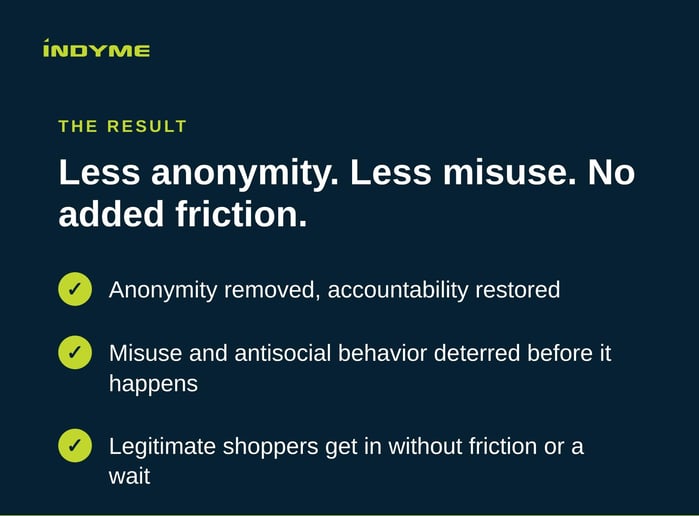
A pin code tells you nothing once it's been handed out. A Freedom GO session tells you who entered, when, and for how long, and that data compounds into things no keypad or standalone lock can offer.


  • Dwell and usage analytics surface peak hours, slow days, and outlier sessions worth a second look, automatically.
  • Repeat-visit detection flags phone numbers showing up far more often than a typical shopper, often revealing non-shopper use of the space that was previously invisible.
  • Suspicious event detection and configurable alarms flag denied credentials, repeated failed attempts, and unusual dwell in real time.
  • Ban lists let a retailer block a specific phone number or loyalty credential across every connected door, not just the one where the problem happened.
  • Freedom GO also feeds Indyme's TrustedShopper risk scoring, so a shopper's behavior at the restroom door carries reputational context across other Indyme-connected access points, not just this one.


None of this requires a bigger footprint on the door. It requires an identity layer that a pin code was never built to have.

Where and How It Fits

Freedom Go covers both applications retailers actually ask about: restrooms (single-stall and multi-stall) and fitting rooms (individual and cluster entrances), treated as equally important, not restroom-first with fitting rooms as an afterthought. The hardware retrofits onto a standard commercial door and cylindrical bore lock, no custom build-out required, which keeps installation simple across a fleet.


Privacy was designed in from the start, in partnership with the Future of Privacy Forum: participation is opt-in, there's no camera and no biometric processing anywhere in the system, and Indyme operates as data processor with the retailer as data controller, with a defined retention and erasure policy. For stores evaluating this alongside an existing pin-code lock, the honest pitch is the one above: this isn't primarily an incident-reduction upgrade at those doors, it's an operational and data upgrade, on top of a credential that can't leak the way a code can.

The Bottom Line

The restroom and fitting room have been the one part of the store nobody could really manage, not because retailers haven't tried, but because nothing at that door had ever been able to tell them who was on the other side of it. Freedom Go changes that math: faster access for honest shoppers, lost anonymity for everyone else, and a data layer the space has never had before.


Curious what that could look like in your stores? Let's talk.

Go to Solution More information
Author

Troy Anderson