
- Home
- Resource Listing
- The New York Retail Worker Safety Act: What Retailers Need to Know
The New York Retail Worker Safety Act: What Retailers Need to Know
Troy Anderson
Retail employees face a disproportionate share of workplace violence, from shoplifting confrontations to more serious incidents. In response, New York passed the Retail Worker Safety Act (codified as New York Labor Law Section 27-e), creating some of the most detailed retail workplace safety obligations in the country. If you operate a retail location in New York State, here's what you need to know.
Let Indyme help you meet the NYC Retail Worker Safety Act requirements.
- Silent response buttons for immediate assistance must be in place in NYC for retail establishments with 500+ workers.
Two Separate Compliance Deadlines
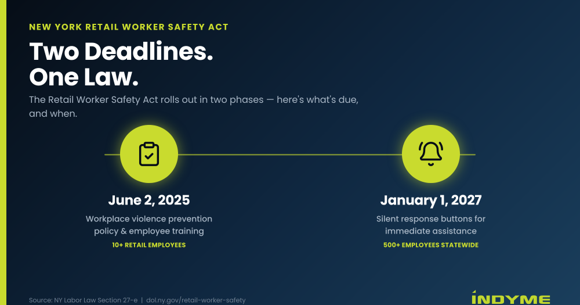
The Retail Worker Safety Act actually has two distinct sets of obligations, phased in on different timelines:
1. Workplace violence prevention policy and training — effective June 2, 2025
Covered employers (10+ retail employees) must:
- Adopt a written retail workplace violence prevention policy
- Provide retail workplace violence prevention training to employees
Training frequency depends on employer size: retailers with 50 or more employees must train new hires upon hire and all employees annually. Retailers with fewer than 50 employees may train once every two years.
2. Silent response buttons — effective January 1, 2027
Employers with 500 or more employees statewide must additionally provide silent response buttons that let an employee quietly request immediate assistance from a security officer, manager, or supervisor in an emergency — plus training on how to use them. We cover this requirement in depth in our next post.
See Indyme's Help Buttons in action!
Get in touch with our team of experts. Whether you're looking for a specific product or a comprehensive solution, our team is ready to provide the guidance you need.
What the Prevention Policy Must Cover
New York's Department of Labor has published model policy and training materials that employers can adapt. At a minimum, a compliant policy should address:
- Risk factors specific to retail work — late-night or early-morning shifts, handling cash, working alone or in small numbers
- Prevention methods, including systems for reporting incidents
- Legal protections available to retail workers under federal and state law
- Anti-retaliation protections for employees who report concerns or exercise their rights
Training must cover de-escalation tactics, active shooter procedures, emergency procedures, site-specific exit and meeting-point information, and the role supervisors and managers play in responding to an incident.
Notice Requirements
Employers must provide required notices in English and, where applicable, in employees' primary languages, if that language is among the twelve most commonly spoken non-English languages in New York State.
A Law Still in Motion
It's worth knowing that this law has already changed once: an amendment signed in February 2025 renamed “panic buttons” to “silent response buttons,” narrowed the device requirement from employers with 500+ employees nationwide to 500+ employees statewide, and adjusted training requirements for smaller employers. That amendment pushed the original compliance deadline back by three months. Given the pace of change, it's worth checking the NY Department of Labor's retail worker safety page periodically for updates.
Getting Started
If you haven't already adopted a written policy and started training, that obligation is already in effect. If you're a larger retailer approaching the 500-employee threshold, now is the time to start evaluating silent response button systems — installation, integration, and staff training all take longer than most teams expect. We'll walk through exactly what the button requirement involves, and how to plan for it, in our next post.
This post is for general informational purposes and isn't legal advice. Consult with counsel to confirm how the Retail Worker Safety Act applies to your specific business.
Troy Anderson