

- Home
- Resource Listing
- Will shoppers really scan a QR code? What 35,007 restroom visits showed
Will shoppers really scan a QR code? What 35,007 restroom visits showed
Indyme
“Shoppers won’t do this” is the first objection we hear about self-service unlock. It is a fair question, and it deserves data rather than reassurance.
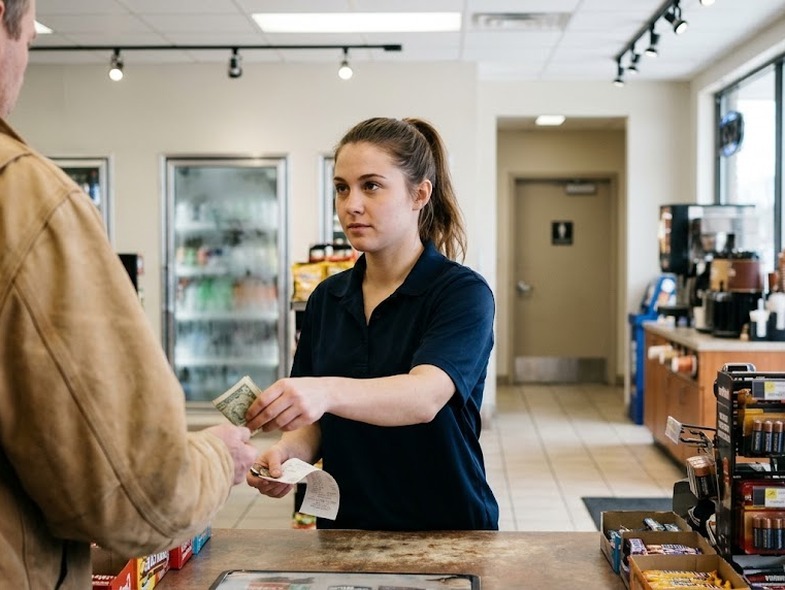
Self-service keeps the associate at the counter.
The study: Results from a joint Indyme and LPRC field study across five stores
From November 2025 to April 2026, Indyme and the Loss Prevention Research Council ran a joint field study of Freedom GO in five retail restrooms, with Dr. Justin Smith, Senior Research Scientist at the LPRC, as research lead. The stores covered both multi-stall restrooms and single-stall, gender-neutral restrooms. Store teams completed daily condition surveys before and after installation.
Adoption from day one
Across the deployment, Freedom GO tracked 35,007 restroom uses and 8,126 unique users identified by phone number.
-
52% of all restroom access was self-service from the first day.
-
About 70% was self-service once associate access events are removed. During the study, associate and customer events shared the same keypad path, so the 52% figure undercounts shoppers.
Adoption was strongest at peak hours, 11 am to 3 pm, which is exactly when associates are busiest and least available to walk someone to a door. Returning shoppers, recognized by their phone, unlocked with zero input.
What associates got back
Every self-service visit is a trip an associate did not have to make. Using the study’s own self-service counts, that adds up to roughly 1,170 hours per store per year, about $23,000 to $24,000 per store per year in reclaimed associate labor at $20 per hour.
That estimate assumes a three-minute round trip for each assisted unlock, where an associate physically walks to the door. If a store’s policy is to read a code over the radio, the savings are smaller. It also annualizes five months of data from five stores.
What happened to incidents
Results on incidents were most promising at stores that had no access control on the door before installation. At stores that already used pin-code locks, the value showed up as labor and data rather than fewer incidents. The LPRC’s researchers describe the findings as mixed but useful and are clear that more testing is needed before broader causal claims can be made. We agree, and we think that honesty matters more than a headline.
What the study can and cannot tell you
Five stores is a small sample, and the stores were not selected by risk level. Dwell time could only be measured at single-stall restrooms. Surveys were not completed every day. We share these limits because a decision about your stores should rest on evidence you can trust.
Next week: the part of the study that surprised us most. Once the door has an identity, the store can finally see what happens behind it.
Indyme