
- Home
- Resource Listing
- Configurable, Not Custom: How SmartDome Adapts to Every Store
Configurable, Not Custom: How SmartDome Adapts to Every Store
Indyme
No two stores lose inventory the same way. A grocery store's biggest shrink category is not a drugstore's. A downtown flagship does not run the same staffing model as a location in a suburban strip mall, and a store that is fully staffed on a Saturday afternoon looks nothing like the same store an hour before closing on a Tuesday. Most loss prevention technology is built around an average case and asks every store to conform to it. SmartDome is built around the opposite assumption: that the differences between stores are the reality a real solution has to work with, not a problem to standardize away.
That is what "configurable, not custom" means in practice. It is not a single product tuned once and shipped everywhere identically, and it is not a custom build for every location that a corporate team can never standardize or support at scale. It is one solution with a set of dimensions a retailer actually controls, store by store, category by category.
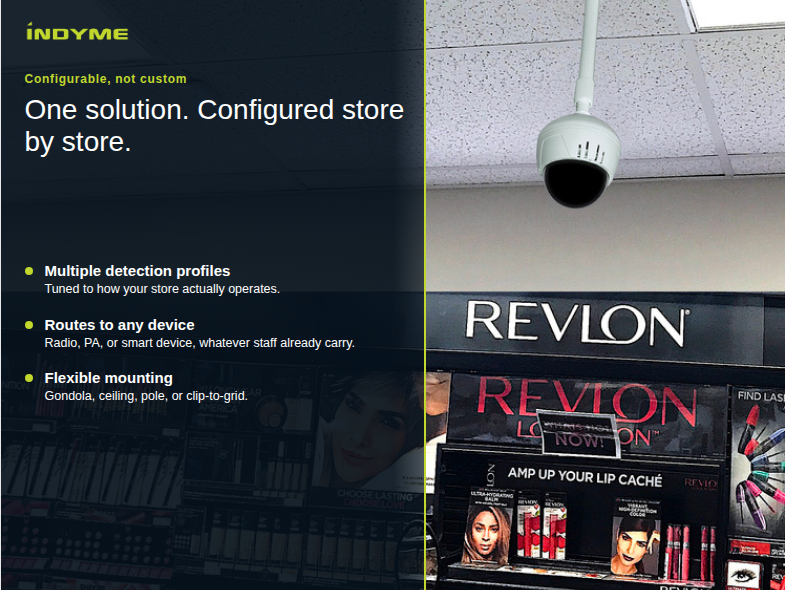
SmartDome mounts to fit the fixture you already have, and its settings change store by store.
- Configurable, not custom. SmartDome is one solution with settings a retailer controls store by store, so corporate can standardize while each location stays tuned to its own reality.
- Detection matches the category. Multiple detection profiles let a retailer set the dwell-time threshold to how shoppers actually behave in each category, instead of one company-wide average.
- It works with what staff already carry. Alerts route over radio, PA, or a smart device, so there’s no new hardware or channel to add before staff can act.
- Response scales to the labor on the floor. It runs from a quiet local light and audible message up to a direct alert to an associate, and retailers decide how often an event reaches a person.
- Mounting fits the fixture. Gondola shelving, ceiling drops, poles, or a clip-to-grid bracket that moves with a reset.
What that looks like on the ground
Picture two stores in the same fleet. One is a 24-hour grocery store where a night-shift baker restocks the same end cap every night at 2 a.m., lingering there for several minutes as a normal part of the job. The other is a drugstore cosmetics aisle where a legitimate shopper rarely stands in one spot for more than thirty seconds, and a much longer dwell time is a meaningful signal. A loss prevention solution tuned to a single company-wide average would either flag the baker every night or miss the cosmetics aisle entirely, depending on which way the average leaned. SmartDome is built so each of those locations can be tuned to its own normal, rather than forcing one definition of "too long" onto every store in the fleet.
Detection tuned to how a store actually operates
Every store has its own definition of a shopper lingering too long near a fixture. In a category with slow, deliberate browsing, a wall of skincare or supplements, for example, a longer dwell time is normal and expected. In a category built for quick, in-and-out purchases, the same dwell time is a much stronger signal. SmartDome supports multiple detection profiles so a retailer can match the threshold to the category and the store, rather than accepting a single setting tuned for an average that does not describe any specific location particularly well.
Meeting staff where they already are
A response is only useful if it reaches someone who can act on it, and different stores equip their teams differently. Some rely on two-way radio. Some route to an overhead PA system. Some are moving staff communication to a smart device instead. SmartDome is built to route a response over whatever a store's staff already carries, rather than asking the store to add a new device or a new channel just to use the technology. That matters operationally: a system that requires new hardware before staff can act on it is a system that takes longer to actually get used.
Response that respects the labor a store actually has
A response can scale from a quiet, local deterrent, the light and audible message that does the deterring on its own, all the way up to a direct alert routed to a specific associate. Retailers can decide how often an event should reach a person for action versus resolving on its own, which matters because the right answer depends on how much labor a specific store has on the floor on a specific day. A flagship store with a dedicated loss prevention presence and a small-format location with two associates on shift do not need to be treated identically, and SmartDome does not force them to be.
Mounting that fits the fixture, not the other way around
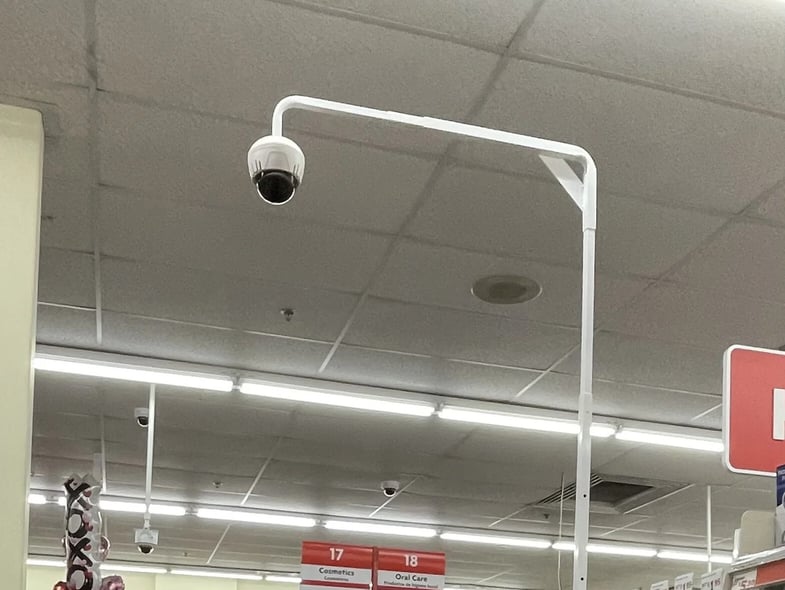
Configurability is not only a software question. SmartDome mounts to gondola shelving, ceiling drops, poles, or a clip-to-grid bracket, so the installation fits the fixture a store already has rather than requiring construction to accommodate the technology. A bracket-mounted unit can also move with a reset, following a category as it shifts around the floor rather than staying fixed to a spot that no longer matters.
Why this adds up to one solution, not four products
None of these dimensions, detection, routing, response frequency, mounting, are separate products a retailer has to integrate. They are configuration choices inside a single solution, which is what lets a corporate loss prevention team standardize on one solution across a fleet while still tuning each location to its own reality. That combination, one solution to manage and support, many configurations to actually deploy, is the point of "configurable, not custom." It is also what makes the pilot results in our companion piece, SmartDome: Research Confirms Its Impact in the Field, possible across 95 different stores that do not lose inventory the same way: the technology adapted to each one, rather than asking each one to adapt to it.
That single-solution structure matters just as much to the team managing the fleet as it does to any one store. A corporate loss prevention group does not want to train staff on four different systems depending on which store they are in, or field support calls for a bespoke build that only one location runs. Standardizing the solution while varying the configuration is what makes a rollout across dozens or hundreds of stores something a lean corporate team can actually support, rather than a project that grows heavier with every new location added.
The bottom line
A fleet of stores is not one store repeated. It is dozens or hundreds of different buildings, categories, staffing patterns, and layouts, and a loss prevention solution that only works when a store looks like the average is a solution that underperforms almost everywhere else. SmartDome scales across a fleet precisely because it does not ask every store to look the same.
Curious what a configuration built around your specific stores could look like? Let's talk.
Indyme