
- Home
- Resource Listing
- Ending the Shrink-vs-Experience Trade-Off in Retail Loss Prevention
Ending the Shrink-vs-Experience Trade-Off in Retail Loss Prevention
Indyme
Ask most retail loss prevention leaders what keeps them up at night, and the answer is rarely just shrink. It is shrink, and the fear of what stopping it costs elsewhere: a customer who feels distrusted by locked cases and visible security, an honest shopper who abandons a basket rather than wait for an associate to unlock a fixture, a brand that starts to feel like it assumes the worst about the people walking through the door. For years, the assumption in the industry has been that retailers have to choose: protect the merchandise, or protect the shopping experience. Active deterrence, done well, is an argument that this trade-off is not actually required.
This tension has only gotten more visible as loss prevention teams operate with tighter staffing and higher expectations at the same time. There are rarely enough associates to watch every aisle, and the ones on the floor have plenty of other responsibilities. A solution that only works by adding more staff, more locked fixtures, or more friction is a solution that fights the reality most stores are actually operating in.
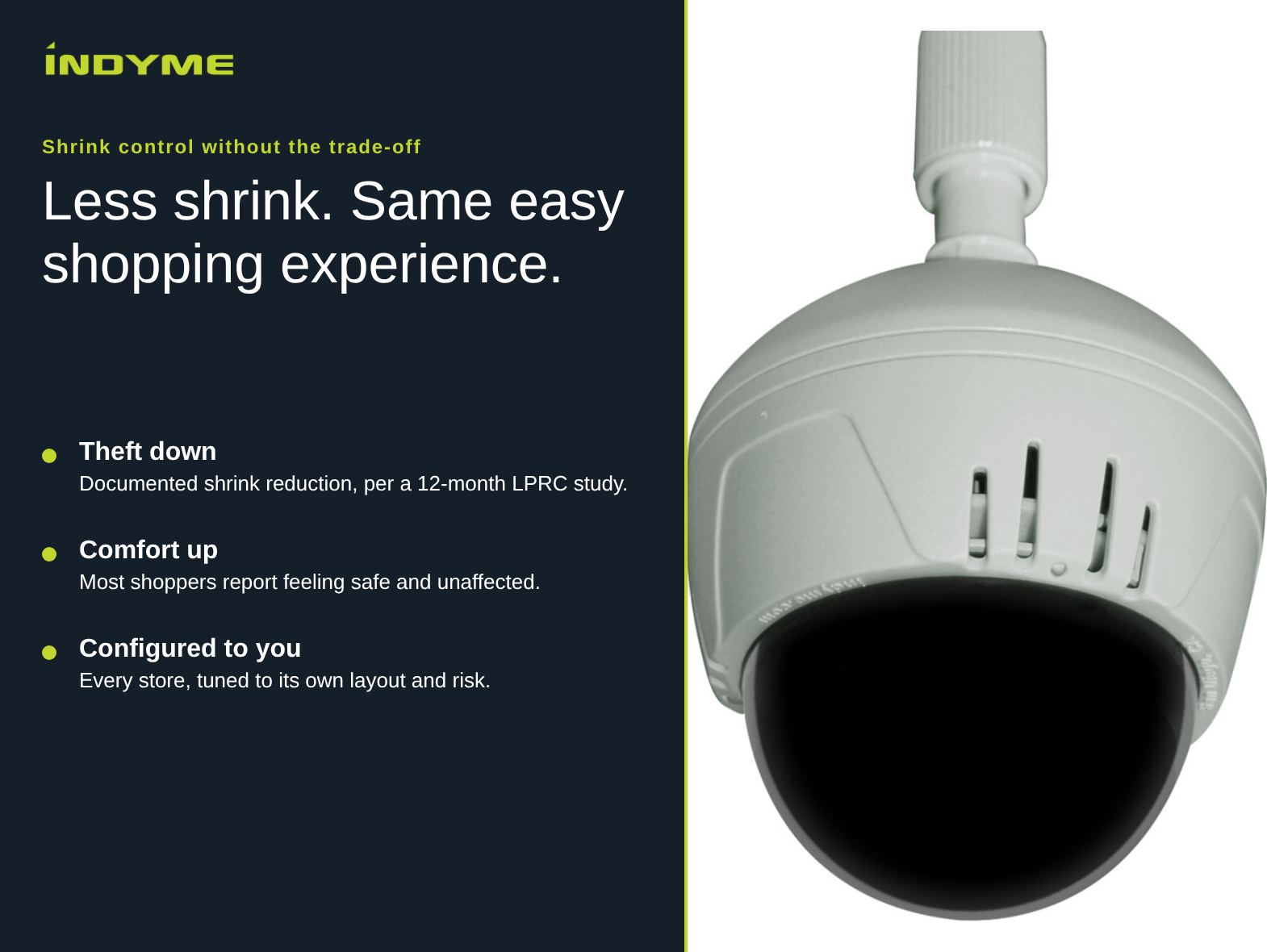
Active deterrence aims to cut shrink without changing the shopping experience.
- The trade-off is an assumption, not a rule. Many common shrink responses do cost something on the experience side, but active deterrence is built to interrupt a moment of risk instead of making a whole category feel adversarial.
- Shrink fell without hurting sales. In the 12-month, 95-store LPRC study, shrink fell 10-15% in the categories covered while category sales rose 1-2%.
- Shoppers stayed comfortable. 90% of shoppers surveyed said they felt somewhat or very comfortable with the technology in place.
- Configurability is what lets results scale. Detection, routing, response, and mounting are tuned store by store, so a pilot result can hold across a fleet that does not look the same.
- Evaluate more than a shrink number. Ask whether it acts in real time, whether the vendor measured customer sentiment, and whether it can be tuned store by store.
Why the trade-off assumption took hold
The instinct is understandable. Many of the most visible responses to shrink genuinely do cost something on the experience side. More locked cases mean more friction and more waiting. More visible guards or aggressive signage can read as an accusation aimed at every customer, not just the ones with something to hide. It is easy to see why retailers have treated shrink reduction and shopping experience as a zero-sum trade, because with a lot of the tools available, it has been.
What the data suggests is actually possible
Independent research on SmartDome’s active deterrence approach, a 12-month, 95-store study conducted with the Loss Prevention Research Council (LPRC) at a national drugstore chain, points to a different outcome. In the categories the technology covered, shrink fell 10-15% while category sales rose 1-2% over the same period, not the pattern you would expect if the technology were simply making the category harder to shop. Offenders who encountered the technology described it changing their decisions in the moment, not after the fact. And customers reported feeling just as comfortable, or more so, in stores using it: 90% said they felt somewhat or very comfortable, and more said it made them more likely to return than said otherwise. We go deeper on this data in SmartDome: Research Confirms Its Impact in the Field.
The honest read of that data is not that active deterrence is magic. It is that the mechanism matters. A response built to interrupt a moment of risk, rather than to make an entire category feel adversarial to everyone in it, does not have to cost the retailer on the experience side to win on the shrink side.
Why configurability is what makes the trade-off avoidable at scale
A single well-designed pilot store is one thing. A fleet of hundreds of stores, each with its own categories, staffing, and layout, is another. The reason active deterrence can hold its results across a fleet like that, rather than only in the store where it was calibrated, is that the solution is built to be configured rather than standardized on a single setting: detection tuned to the category, response routed to whatever device staff already carry and how often it reaches a person versus resolving on its own, mounting that fits the fixture a store already has instead of demanding new construction. Our companion piece, Configurable, Not Custom: How SmartDome Adapts to Every Store, walks through each of these in detail.
That configurability is not a nice-to-have layered on top of the deterrence story. It is the reason the deterrence story holds up outside of a single, carefully chosen pilot location.
What to look for when evaluating active deterrence
Not every technology marketed as active deterrence will hold up to the same standard. A useful evaluation asks a few plain questions of any option under consideration. Does it interrupt a moment of concern in real time, or does it only produce footage to review later? Does the vendor have independent research on customer sentiment, not just a shrink number, so you can see whether the experience side of the trade-off was actually measured? And can it be tuned store by store, category by category, or does it assume every location in the fleet behaves like the one it was piloted in? A technology that cannot answer the third question convincingly is unlikely to reproduce its pilot results once it reaches store two hundred.
What this means for loss prevention
If shrink control and customer experience feel like they are pulling in opposite directions in your stores today, that tension is worth naming directly rather than treating as an unavoidable cost of doing business. The evidence from active deterrence suggests it is possible to reduce theft, measurably and in a category as difficult as cosmetics, without asking your honest customers to feel surveilled while they shop, and without asking every store in the fleet to look and operate identically to get there.
The bottom line
That is the standard worth holding a loss prevention investment to: not shrink dollars in isolation, and not customer experience in isolation, but both, measured together, across a fleet that does not look the same from one store to the next.
If shrink and customer experience feel like they are pulling in opposite directions in your stores, let’s talk.
Indyme